
Local Reputation vs. Visibility: How AI Changes Trust in 2026

Craig Hadley
Director of Digital Strategy & Insights
Local Reputation, Local Visibility, and Your Story
I’ve noticed that when I understand how a business operates, who they work with, what they prioritize, and what story they are trying to tell, I show up differently as a customer. I’m not less critical. I’m just more trusting.
The experience doesn’t change, but my mental posture does.
People don’t evaluate experiences in a vacuum. We interpret them through the context and the trust we bring with us. When trust is present, my judgment becomes more measured. Not softer, but fairer.
The “Sushi Test”: A Lesson in Proxy Signals
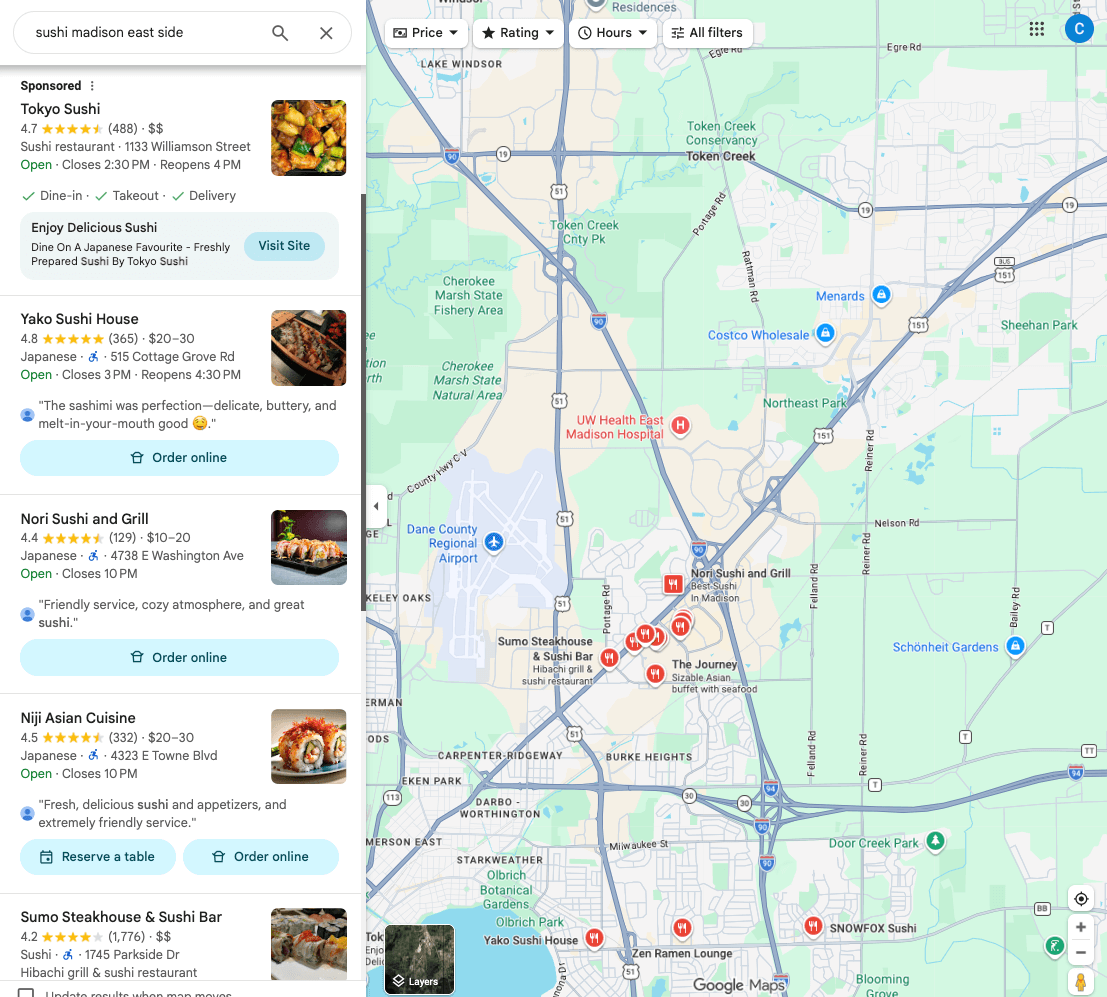
I think of choosing a sushi restaurant as the ultimate “trust fall.” Before I ever take a bite, I am scanning for “proxy signals” of care.
- Their Digital “Scent”: I start with reviews. I’m not just looking at the stars; I’m looking for keywords that signal what I value. If the recent narrative is positive, I’ve often decided to trust it before I even park the car.
- Operational Clarity: Are the hours accurate? Is the Google profile well-maintained?
- The Physical Space: Is it clean and neutral, or is there a faint, weird odor signaling a lapse somewhere?
- The Menu: Is it focused, or is it trying to hide low-quality fish behind ten different spicy mayos?
The Narrative Gap: Why Data Isn’t Enough
There is a profound difference between being accurate and being intentional.
Most businesses treat their digital presence like a tax filing. They want to ensure the boxes are checked and the numbers are right. But when I say that understanding a business’s story makes me more trusting, I am talking about the Narrative Gap.
- Data says: “We use organic flour.”
- Narrative says: “We spent six months visiting four different mills because we wanted a specific protein content that makes our crust crunchier.”
One is a fact. The other is a vision.
When an AI like Gemini or ChatGPT scans your reviews and website, it isn’t just looking for keywords. It is looking for a consistent thread of care. If your story is visible, the AI doesn’t just list you as a result. It recommends you as a solution. If your customers mention why you do what you do and your website explains who you prioritize, you move past simple visibility.
Trust isn’t built by being correct. It is built by being understood.
Our Threshold of Action
This process isn’t instant. Consumer research shows that in 2026, the average buyer engages with roughly 20 to 30 distinct digital signals before reaching out to a local business.
We are looking for consensus across Google, AI summaries, and social proof. If a business only provides five or ten signals, you haven’t reached the “certainty threshold” required for a lead to convert. Trust is built through the volume of your intentionality.
If we see these signals of intentionality, we enter with a posture of trust. If the food is slow, I assume the kitchen is being meticulous. Without those signals, I presume they are disorganized. The wait time is the same, but my interpretation is entirely different.
Where Reputation and Visibility Drift Apart
Reputation lives in a shared human context. Visibility is governed by systems, and in 2026, those systems are being synthesized by AI.
I’ve seen that AI platforms like ChatGPT and Google Gemini are far more selective than traditional search. While a brand might appear in a map list 36% of the time, ChatGPT recommends only 1.2% of locations. Essentially, the “visibility” you have on a map does not automatically translate to “recommendability” in a conversational AI context.
The Benchmarks: Moving from “Good” to “Best”
In a system-mediated world, visibility doesn’t reward intent; it rewards clarity. I look at review profiles across three tiers:
Expanded Visibility Benchmarks
The volume needed for competitive visibility varies by the “trust threshold” of your industry:
- Restaurants & Cafes: 100+
- Retail (Boutiques/Specialty): 80–120
- Apartments & Multi-family Housing: 70–100
- Healthcare (Dentists/Doctors): 60–100
- Beauty & Wellbeing: 50–80
- Home Remodeling & Kitchen Design: 45–70
- Home Services (HVAC/Plumbing): 40–60
- Legal Services (Law Firms): 25–55 (high weight on professionalism and specific case results)
- Professional Services (Finance/Accounting): 20–50
- Real Estate Agents: 15–30
The Real Risk is Being Unknown
Reviews function as a stand-in for understanding when other context is missing. If a customer or an AI algorithm doesn’t know what to expect, they fill the gap with suspicion.
Local reputation still matters deeply, but it no longer carries the same weight. We have to design visibility so that when people and systems judge a business, they are responding to what is really there, not to what is missing.
Beyond the Map: Documenting Your Intentionality
The real risk in 2026 isn’t just being unranked. It is being misunderstood. If an AI system cannot find the “why” behind your business, it will fill that gap with a generic or “hallucination” summary. It won’t have the context to give you the benefit of the doubt.
Accurate data is just the skeleton. To build real trust, you have to provide the flesh. You have to make your priorities and your story visible to the systems that now decide who gets found.
Is your brand “AI-Ready”?
The most significant shift in 2026 is that AI systems now act as the primary gatekeepers of trust. These systems are looking for a reason to recommend you. If they cannot find a clear, documented fact base for your business, you risk becoming invisible to the very customers who are looking for you.
We are launching a new AI Fact Sheet Service designed to help local brands stay aligned with how modern systems evaluate and recommend businesses. We help you document your intent, your expertise, and your care in a language that AI and your customers can finally understand. We make sure the system knows your story so it can vouch for your reputation.

Craig Hadley
Director of Digital Strategy & Insights at The Creative Company
Other Recent Articles:
- Would an AI vouch for you?
- When “AI This” and “AI That” Isn’t Enough
- From Clicks to Foot Traffic: How Geofencing Turns Online Ads into Real-World Results
- Should QR Codes be Part of Your Video Marketing? Lessons from the Super Bowl
- Breaking Up is Never Easy – Goodbye Andes Candies (It was us, not you)
- Revitalize and Reignite Your Content Strategy: A Guide to Content Republishing